
Research Projects
Authentication Security
In these works, we primarily analyze the security of state-of-the-art authentication systems and their vulnerabilities against well-designed attacks. The scope of these projects includes designing novel attack frameworks, evaluating the security of authentication systems using technical assessments and real-world user studies, and finally, securing these systems by mitigating the identified vulnerabilities with the help of modern AI/ML techniques.
FIDOLA
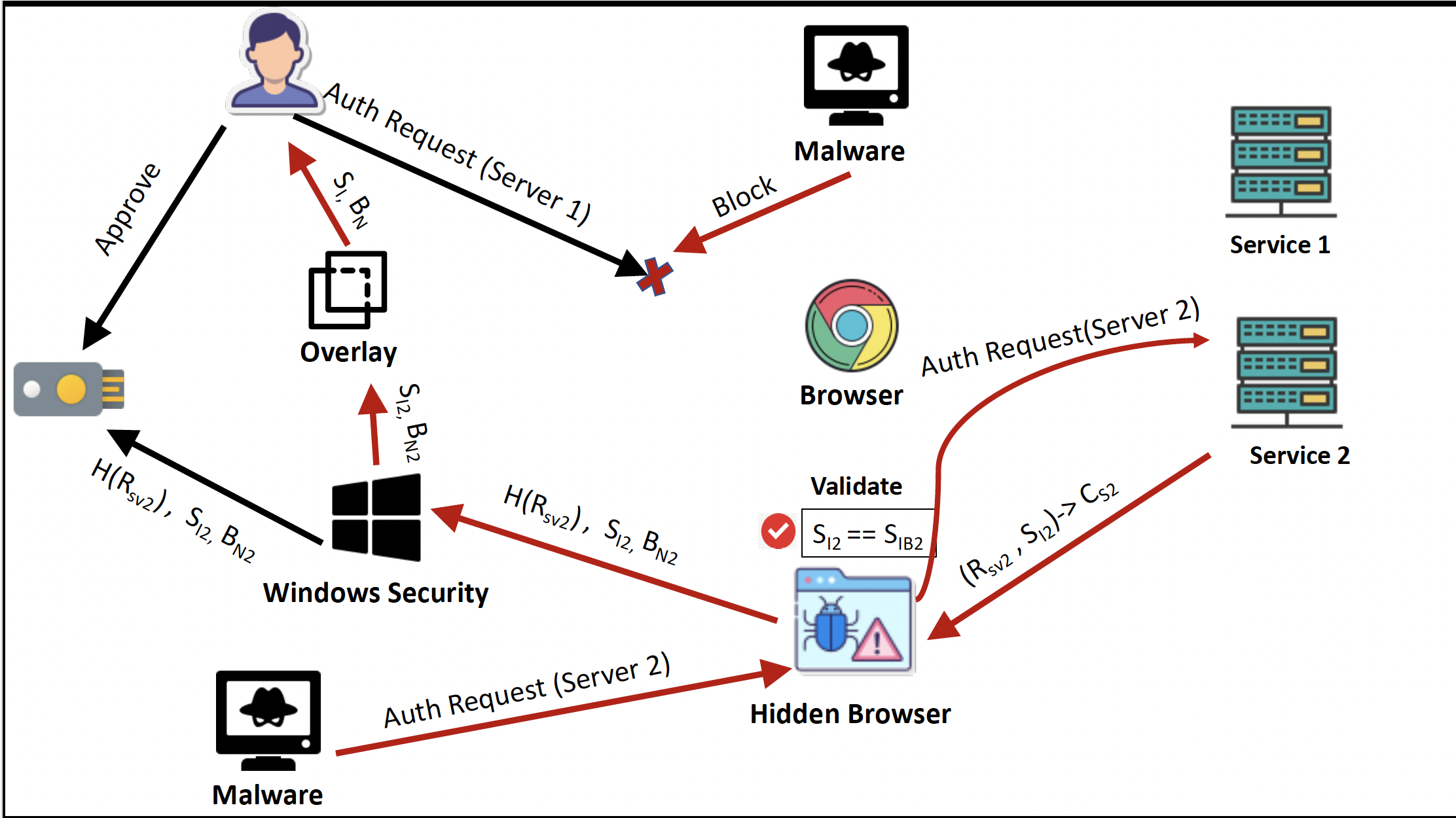
This research examines the security of FIDO2 hardware security keys used in two-factor and passwordless authentication systems. We develop an attack framework called FIDOLA (FIDO2 Deception Attack via Overlays exploiting Limited Display Authenticators), which injects hidden login sessions and deceives users into approving malicious requests through limited authenticator displays.
Our analysis of FIDO2 protocols and OS-level security, combined with practical demonstrations, reveals a critical vulnerability not addressed in current specifications or prior research. A user study shows that 95.55% of participants approved cross-service attacks when presented with deceptive overlays, highlighting a serious real-world threat to account security.
Notification-based Authentication
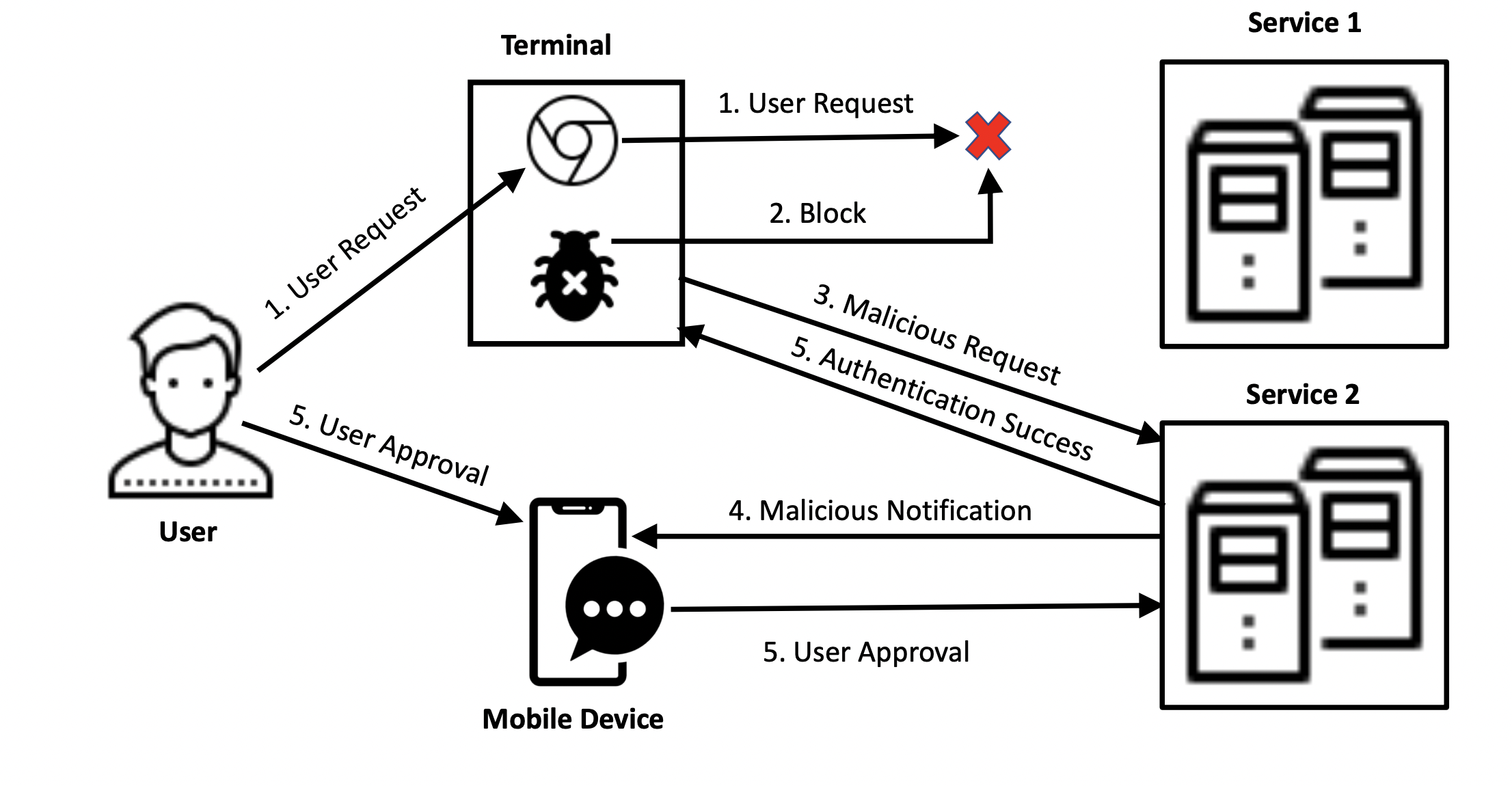
This work evaluates the security of notification-based authentication systems, a popular 2FA and passwordless solution using mobile notifications, when a user’s computer is compromised by malware such as keyloggers or malicious extensions. We show that limited information in the authentication workflow can lead users to approve fraudulent requests, enabling cross-service attacks where an attacker authenticates to Service B while the user intends to access Service A. Our proof-of-concept demonstrates vulnerabilities across multiple systems, and a user study reveals an 82.2% success rate for such attacks, highlighting a critical weakness that allows account compromise without breaching the possession-factor device.
OTP-based Authentication
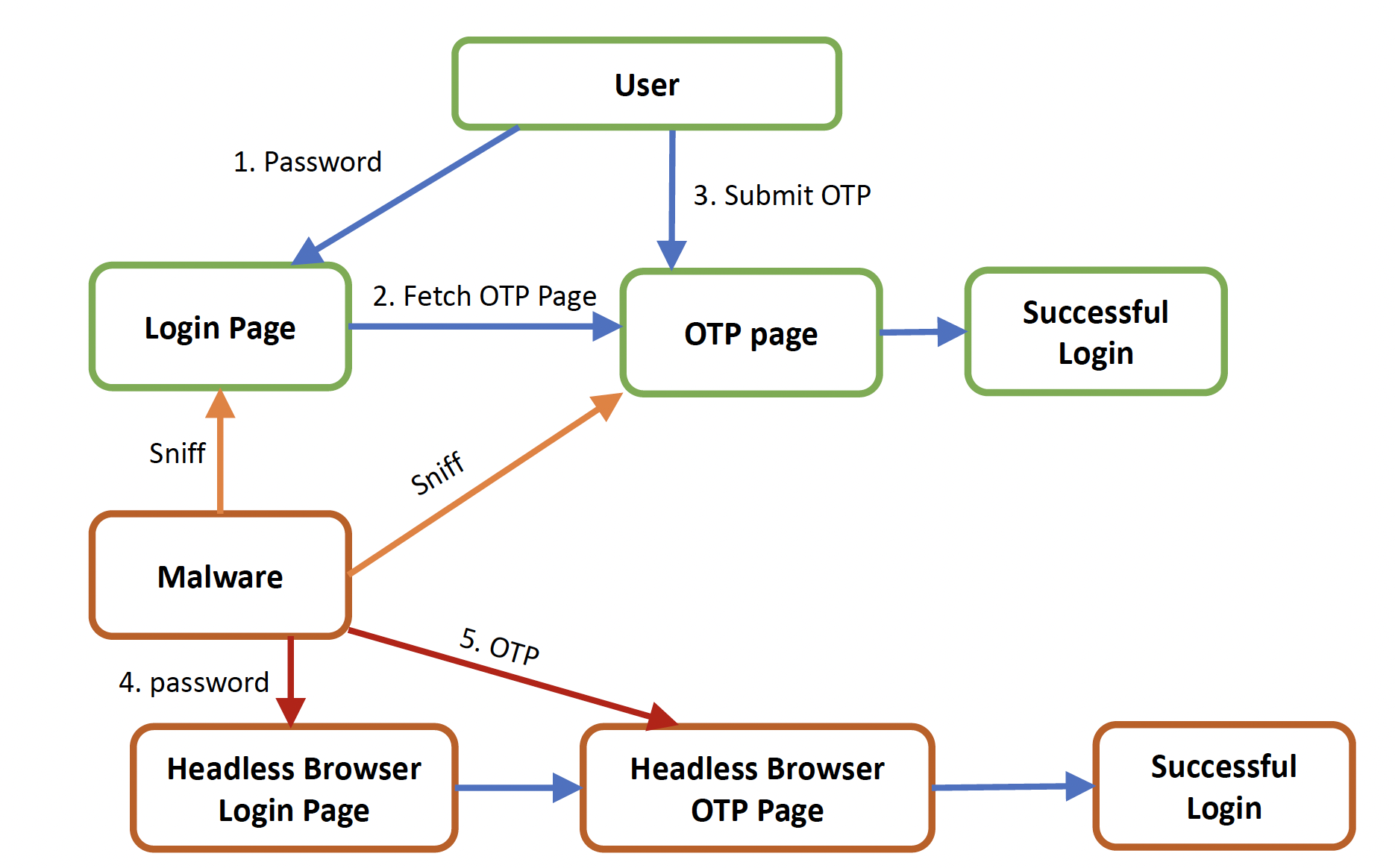
This work evaluates the security of seven widely used OTP-based two-factor authentication (2FA) schemes against malware operating in the terminal without compromising external devices or services. We develop attack modules that capture both passwords and OTPs during login and initiate hidden concurrent sessions to gain account access. Tested on popular public services, our findings reveal that nearly all OTP-2FA implementations are vulnerable to this attack, which requires no root privileges and runs stealthily with minimal resources, evading major anti-malware programs. These results demonstrate that OTP-2FA offers little additional security over passwords when a user’s terminal is compromised.
BadAuth
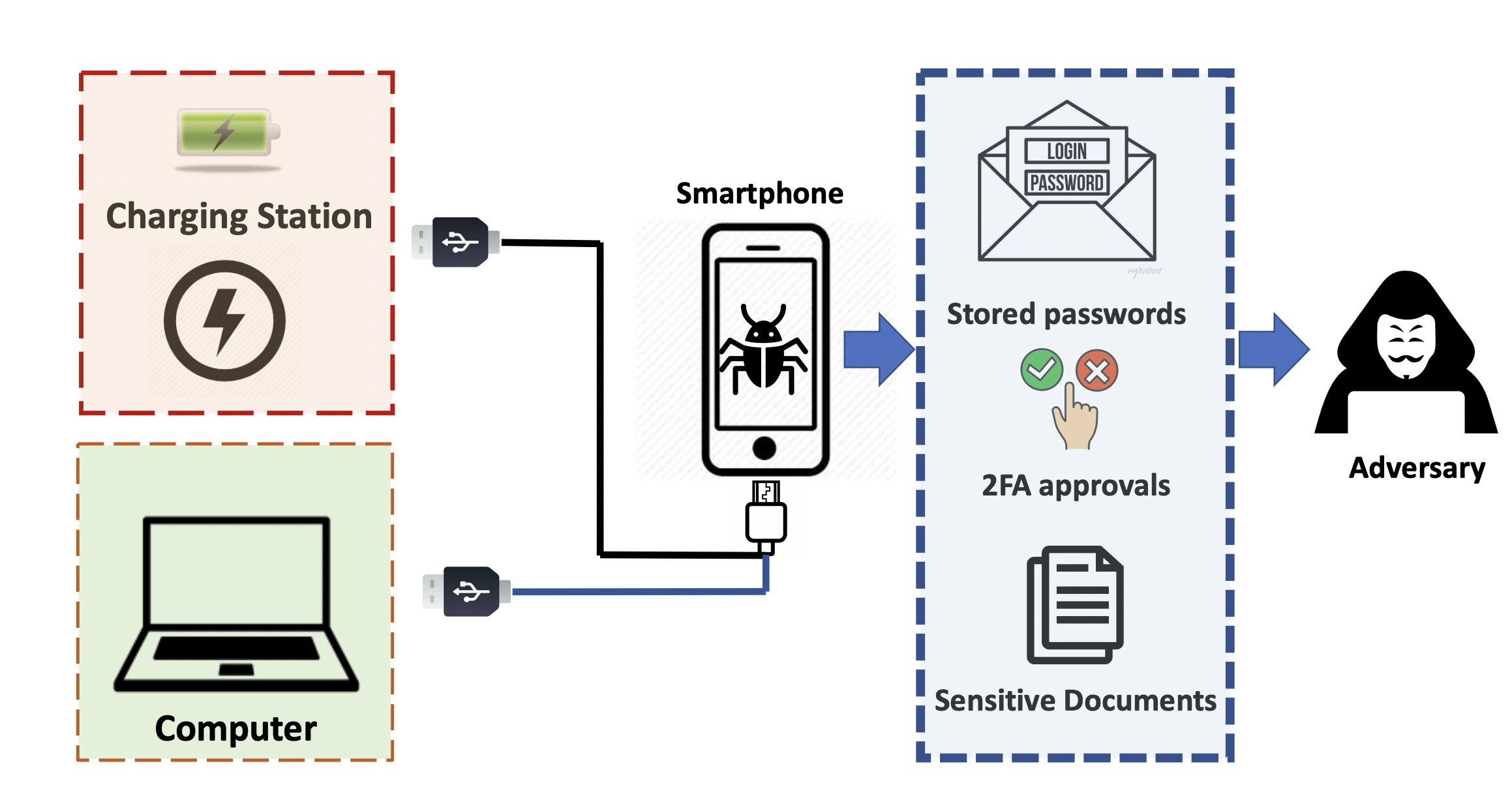
This paper investigates the security implications of the Android Debug Bridge (ADB) vulnerability on modern authentication systems, browser-based password managers, and financial applications. We introduce the BADAuth attack, which exploits ADB utilities to compromise non-rooted devices running the latest Android version. Our findings reveal that attackers can execute a one-time attack to access multi-factor authentication systems and extract all passwords stored in browser-based managers, enabling large-scale breaches. Additionally, we demonstrate privacy and security risks for financial and e-commerce apps under BADAuth attacks and propose potential mitigation strategies.
Side-channel Analysis of Smart Devices
In these works, we investigate side-channel information leakage from smart devices such as smartphones, smartwatches, and AR/VR devices. Specifically, we examine how zero-permission motion sensor data can be exploited by attackers to extract sensitive private information from users based solely on vibrations captured by these sensors. Our findings reveal several interesting types of information that can be inferred, including gender, speaker identity, emotion, speech content, and vital signs.
EmoLeak
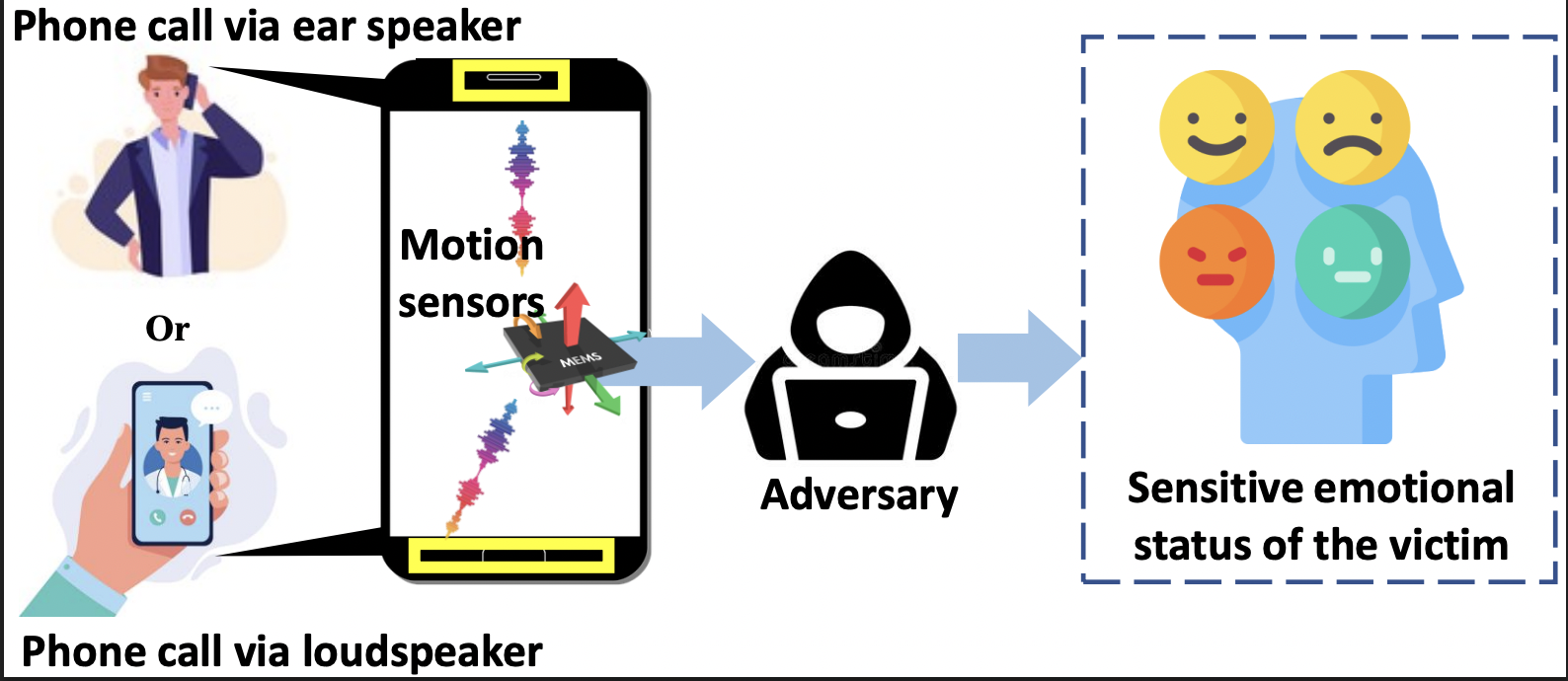
This work explores the feasibility of emotion recognition through zero-permission motion sensors on smartphones, revealing a new privacy risk. We show that voice played through a smartphone’s loudspeaker or ear speaker generates vibrations that encode emotional information, which can be extracted using time-frequency features and machine learning techniques. Evaluating our approach on multiple smartphones and public emotion datasets, we achieve up to 95.3% accuracy for loudspeaker settings and 60.52% for ear speaker settings, demonstrating a significant threat of emotional state leakage without requiring access to cameras or microphones.